Gathr
Automatisk aggregering og publicering af indhold
Overvåger websites, sider på sociale medier, feeds, PDF-dokumenter og API'er, udtrækker de felter, der betyder noget, og samler den samme information fra flere kilder i én post, klar til publicering. Intet udgives uden kundens beslutning.
Newsrooms, portals, online shops, B2B firms, agencies and institutions that follow information across many sources
- Schema.org
- REST API
- Webhooks
- RSS / Atom
- Cloudflare
KIKLAB SOLUTIONS SRL
Om produktet
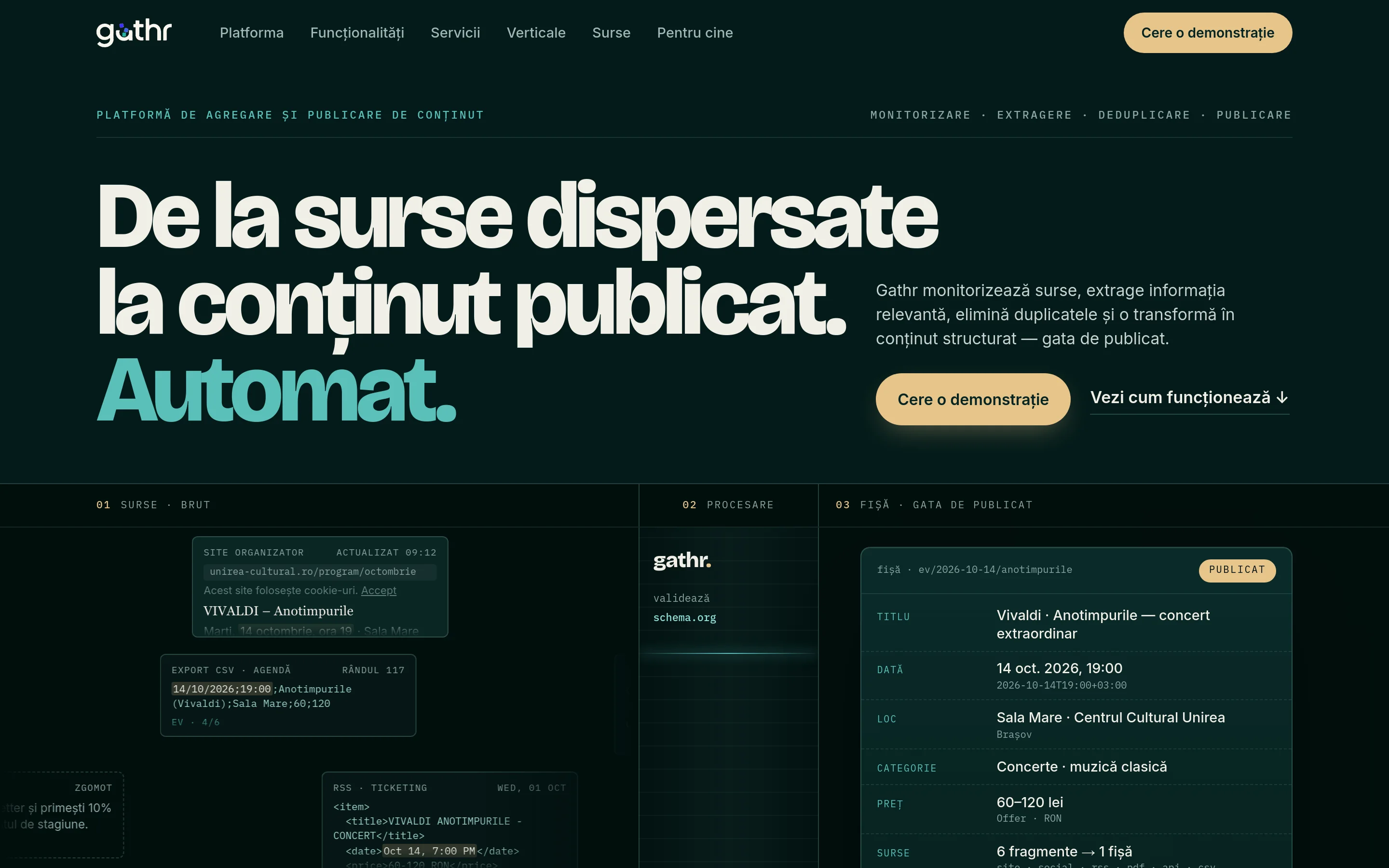
Gathr's premise sits in the heading of a section on its own site: the information "already exists", and the problem is "turning it into something usable". The same concert shows up on the organiser's website, on a social media page, in an RSS feed, in a PDF press release, in an API response and in a CSV export — each with its own format and its own noise, and the date written five different ways. The platform runs all of those sources through one five-stage flow — monitoring, extraction, normalisation, deduplication, publishing — and delivers a single structured record at the end.
Monitoring covers six kinds of source — web pages, including those that load content as you scroll, social media pages and events, RSS/Atom feeds and sitemaps, JSON-LD data and ICS calendars, email and APIs, PDF documents — in scheduled runs with a volume cap per run. From each source it extracts the fields that matter for the domain and leaves menus, ads and cookie banners behind. Normalisation turns "14.10", "Oct 14, 7:00 PM" and an ISO timestamp into the same date, and deduplication recognises the same information under different titles, URLs and formats and merges it into one record more complete than any single source, with every source kept and traceable. The record then goes to a website, a feed, a newsletter or an app, with SEO and Schema.org structured data already filled in.
Editorial control is one of the three principles on the About page, summed up there in one line: "the platform proposes; the human decides". A change arriving from a source shows up as a per-field diff and waits for the client's decision, manually edited content is not overwritten on reprocessing, and every run, change and publication stays in the history with its source, time and author. The client also chooses, source by source, how far the text goes — a faithful import, an adaptation to their own editorial style, or a new article built from the facts of several sources — and, under the terms, carries the obligation to configure only sources they have the legal right to process. The same platform is adapted to twelve verticals, from events and e-commerce to public procurement, EU funding and legislative monitoring.
StatusThere is no direct sign-up on gathr.ro: access starts with a demo request — through the form or by email — and the demo is run on the client's own sources. The working model is chosen afterwards from the five the site describes — self-service platform, setup with maintenance, data over an API or feed, B2B alerting, and white-label for agencies.
Hvad det gør
Six kinds of source, one flow
Web pages, dynamic ones included, social media pages and events, RSS/Atom feeds and sitemaps, JSON-LD and ICS calendars, email and APIs, PDF documents. From a listing page the platform finds the detail pages on its own, with no page-by-page configuration.
One record, not five
Deduplication recognises the same item even when it arrives with different titles, URLs or formats. The resulting record combines the sources' fields — the description from one, the price from another, the image from a third — and keeps every source attached and traceable.
One taxonomy, whatever the source
Calendar dates in the local time zone, categories, cities, venues and genres in controlled vocabularies, images brought to the same size.
Nothing is published without a decision
A change arriving from a source shows up as a per-field diff, to be approved, rejected or edited. Manually edited content survives reprocessing, and important fields can be locked.
Three content modes, chosen per source
A faithful import, where content is restructured rather than reinvented; an import adapted to the editorial style; or a new article built from the facts of several sources. Separately, a topic can be searched across several sources at once and turned into a summary article, with provenance kept.
SEO and structured data included
Title, description, keywords and slug on every item, Schema.org structured data and FAQ sections, for Google, Discover and AI answer engines.
One dataset, many destinations
WordPress, headless CMSs, online shops, webhooks, a REST API and a JSON feed, CSV/XLSX and ICS export. Every item carries a visible state — published, pending, modified.
History, roles and several clients
Every item keeps its source, the moment it was fetched and its action history. Access has four roles — admin, manager, editor, viewer — and several clients, verticals or sites are run from the same platform.
Casestudierne findes på rumænsk og engelsk. Resten af sitet er oversat fuldt ud.
Vil du have et produkt bygget sådan?
Det samme team, der holder disse applikationer i drift, kan bygge det, du har brug for. Fortæl os, hvor I står, så får I en konkret vurdering retur.
Få tilbud